Orbital Weather: Planning Deep-Sky Sessions Around Satellite Traffic in 2026
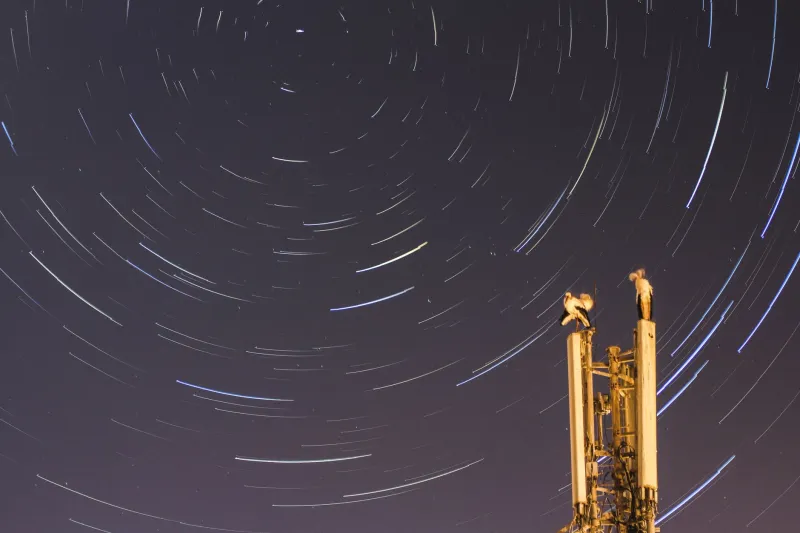
Satellite trails used to feel like bad luck. In 2026 they are a recurring feature of the deep-sky data stream, especially in the first and last hours of a clear night and in wide fields that cover large swaths of sky. The practical response is not to abandon a session when a streak appears. It is to plan for streaks the way one plans for moonlight: as a known condition that shapes target choice, exposure strategy, and processing.
Know What Is Crossing Your Field
Most of the interference comes from low-Earth-orbit satellites, which cross the sky quickly and can leave a bright line across a sensor during a long exposure. Brightness varies enormously with solar angle, satellite attitude, and the geometry between observer, satellite, and Sun. A pass that is invisible to the naked eye can still register in a deep stack. A pass that looks dramatic in a wide-field frame may vanish entirely in a narrow field or a short sub.
The first step is to stop treating every trail as an emergency. A single contaminated sub is usually a minor loss. A session with dozens of contaminated subs is a planning problem. The distinction matters because it determines whether the answer is better rejection software or a different acquisition plan.
Build an Orbital Forecast
Satellite prediction is now part of site preparation. Tools such as CelesTrak, Heavens-Above, and the satellite plug-ins in planetarium software can generate pass predictions for a specific latitude and longitude. The key is to check them before the session, not after. Note the times in UTC, identify the busiest windows, and compare those windows with the targets you intend to shoot.
You do not need to identify every satellite in every frame. You need to know when traffic density rises. For many US locations, the hour after sunset and the hour before sunrise are especially busy because satellites are still sunlit while the sky is dark enough for imaging. Wide-field mosaics and long integrations near the celestial equator can be more exposed simply because they cover more sky for more time.
Choose Targets and Windows
Planning around satellite traffic does not mean avoiding the sky. It means matching the session to the forecast. If a high-value target is available only during a busy window, collect more subs than usual and accept that some will be rejected. If the forecast is crowded and the target is bright, consider a shorter integration on a different night rather than forcing a marginal result.
Target altitude matters. Low-altitude frames pass through more atmosphere and often show more sky glow, which can make faint trails harder to distinguish from background. High-altitude frames are not immune, but they are often cleaner. Narrowband imaging can reduce sky background, yet it does not make a bright satellite trail disappear; it can make the trail more conspicuous against a dark, low-noise background.
Acquire for Rejection
The most reliable defense is redundancy. A stack built from twenty subs gives rejection algorithms little room to work. A stack built from sixty or more subs gives them a statistical basis for identifying a moving line without damaging the stars and nebulosity around it. Dithering helps because it shifts the trail relative to the fixed sky from frame to frame, making the artifact easier to isolate.
Exposure length is a trade-off. Shorter subs produce shorter trails, but they also increase the number of frames and can raise read-noise contributions if the camera is not operating in a low-noise regime. Modern CMOS cameras have made shorter exposures more practical, but the right choice still depends on the target, the filter, and the sky background. Do not shorten exposures reflexively; shorten them when the forecast and the camera support it.
Stacking Is Not a Wastebasket
Rejection is statistical, not magical. Sigma clipping, median combination, and linear-fit rejection can remove a satellite trail when enough clean samples exist at each pixel. They can also remove faint signal if pushed too hard. The result is a familiar failure mode: a clean-looking image with a subtly eroded nebula and a background that no longer behaves like the rest of the data.
Inspect the individual frames before trusting the stack. Run rejection diagnostics if your software provides them. If a trail crosses a bright star or a compact nebula, masking that region in the affected subs may be better than aggressive global rejection. Sometimes the most honest choice is to discard a contaminated sub and move on. A slightly smaller stack is preferable to a stack that has been clipped into unreality.
Document and Report
Interference is also data. When a trail appears, record the date and time in UTC, the observing location, the target, the exposure length, the field of view, the camera orientation, and the approximate number and brightness of trails. If the satellite can be identified from the prediction, note it. This information is useful for your own planning and for the broader effort to characterize orbital interference.
The International Astronomical Union Centre for the Protection of the Dark and Quiet Sky maintains channels for reporting and studying satellite interference, including SatHub. Reports from amateur imagers can help document brightness and occurrence rates that are difficult to capture at scale. Precision is more useful than outrage: a well-labeled observation contributes more than a complaint.
Keep the Session in Perspective
Satellite trails are not a moral failure and they are not a reason to give up on deep-sky imaging. They are one more variable in a sky that already includes clouds, moonlight, smoke, and haze. The imager who checks the orbital forecast, collects enough data, dithers deliberately, and rejects with restraint will still produce clean images. The imager who ignores the forecast and expects software to clean up every problem will spend more nights fighting the stack than reading the sky.