Surrender to the Frame: How Letting Go of Perfection Unlocks Your Best Astrophotography
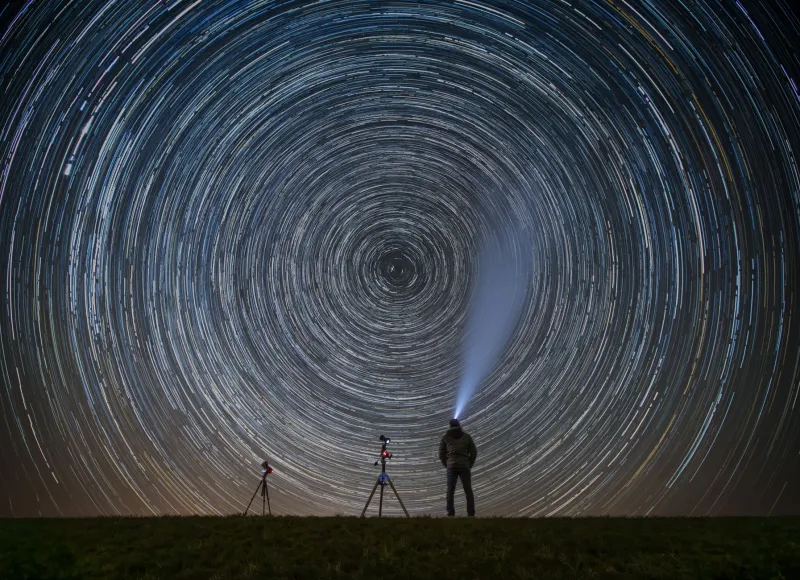
There is a particular kind of paralysis that visits nearly every serious astrophotographer at some point. It arrives not in the form of cloudy skies or a failing mount, but as a quiet, internal voice insisting that tonight is not quite right — the seeing is mediocre, the new filter hasn't arrived, the moon is three degrees too close to the target. The session never begins. Another clear night evaporates. And paradoxically, the pursuit of the perfect image produces no image at all.
This is the patience paradox at the heart of the hobby: the imagers who produce the most compelling work are rarely those with the most optimized setups. They are the ones who learned, often through frustration, to release the grip of perfectionism and simply point their telescope at the sky.
The Perfectionism Trap
Perfectionism in astrophotography typically manifests in two forms. The first is gear obsession — the conviction that the next camera, the next focal reducer, or the next mount will finally unlock results that current equipment cannot deliver. The second is condition fixation — the belief that meaningful imaging can only occur under a specific convergence of seeing, transparency, and lunar phase that arrives perhaps three or four times a year.
Both patterns share a common root: they externalize responsibility for outcomes. If the gear or the conditions are the limiting factor, then the imager is never truly tested. There is always a plausible excuse for why this session's results fell short.
The problem is that this logic is self-reinforcing. Each upgrade delivers a marginal improvement but does not resolve the underlying dissatisfaction. Each deferred session represents lost practice time — the one currency that cannot be purchased.
Case Study: The Imager Who Stopped Waiting
Consider the trajectory of a hobbyist in the mid-Atlantic United States who spent the better part of two years researching camera upgrades before making a single deep-sky image. His forum posts were meticulous, his spreadsheets comparing sensor specifications were genuinely impressive, and his knowledge of theoretical imaging parameters was considerable. His image count, however, remained at zero.
The shift came not from a new purchase but from a conversation with a local astronomy club member who had been imaging for fifteen years with a camera that was, by current standards, decidedly modest. That imager's gallery contained extraordinary work — rich hydrogen-alpha detail in the Cygnus Wall, a genuinely moving portrait of the Andromeda Galaxy captured from a suburban backyard in New Jersey.
The difference was not equipment. It was hours behind the eyepiece and hours at the processing workstation. It was the willingness to image on a Thursday in March when the transparency was merely adequate, because merely adequate skies still contain photons.
Within six months of abandoning his research paralysis and beginning to image regularly with the equipment he already owned, the mid-Atlantic imager produced results that exceeded anything he had imagined his gear capable of delivering.
Distinguishing Optimization from Procrastination
This is not an argument against thoughtful gear selection or against caring about image quality. Both matter. The relevant question is whether a given decision — to wait, to research, to defer — is serving the work or substituting for it.
A useful diagnostic framework involves three questions:
1. Is this decision reversible? Choosing not to image tonight is reversible in theory but not in practice — that specific sky, at that specific moment, is gone. Choosing to delay a camera purchase by another month carries far lower stakes.
2. Would imaging tonight teach me something that research cannot? Almost always, the answer is yes. Processing real data from a real session reveals far more about the actual performance of a system than any specification sheet.
3. Am I solving a demonstrated problem or an imagined one? If you have not yet imaged the Orion Nebula, you do not yet know whether your current sensor is inadequate for it. The problem may not exist.
When deferral consistently fails these tests, it is procrastination wearing the costume of optimization.
The Productive Imperfection Framework
Amateur astronomers who have made the psychological shift toward productive imperfection tend to describe the same realization: the flawed image they actually captured taught them more than the perfect image they imagined. A frame with slight trailing reveals mount behavior that no specification document could have predicted. A noisy stack from a suburban backyard shows exactly where processing skill needs development.
In this sense, imperfect data is not merely acceptable — it is actively instructive. Every session, regardless of conditions, generates feedback that a deferred session cannot.
Practically, this shift requires building a habit of what might be called threshold imaging: setting a minimum viable condition that triggers a session, rather than a maximum ideal condition that must be met before one begins. A reasonable threshold for most deep-sky imagers might be any night with seeing above 2 on the Antoniadi scale, transparency above average, and no significant precipitation forecast. Nights meeting that threshold are far more common than the rare convergence of ideal conditions.
What Acceptance Actually Produces
The irony embedded in the patience paradox is complete: the imagers who accept limitation most readily are the ones who most consistently transcend it. By accumulating hours rather than waiting for the perfect hour, they develop processing intuition, mechanical familiarity with their equipment, and the kind of target knowledge that only comes from repeated engagement with the same object across different conditions.
The universe does not hold its breath waiting for your setup to be perfect. It continues expanding, its nebulae continue emitting, and its photons continue traveling billions of years across the cosmos to arrive, indifferently, at whatever aperture you happen to have pointed skyward tonight.
Capture the frame. Analyze it honestly. Improve the next one. That is the whole practice — and it begins the moment you stop waiting for conditions that may never arrive.