The Art of the Unfilled Frame: Composition for Deep-Sky Astrophotography
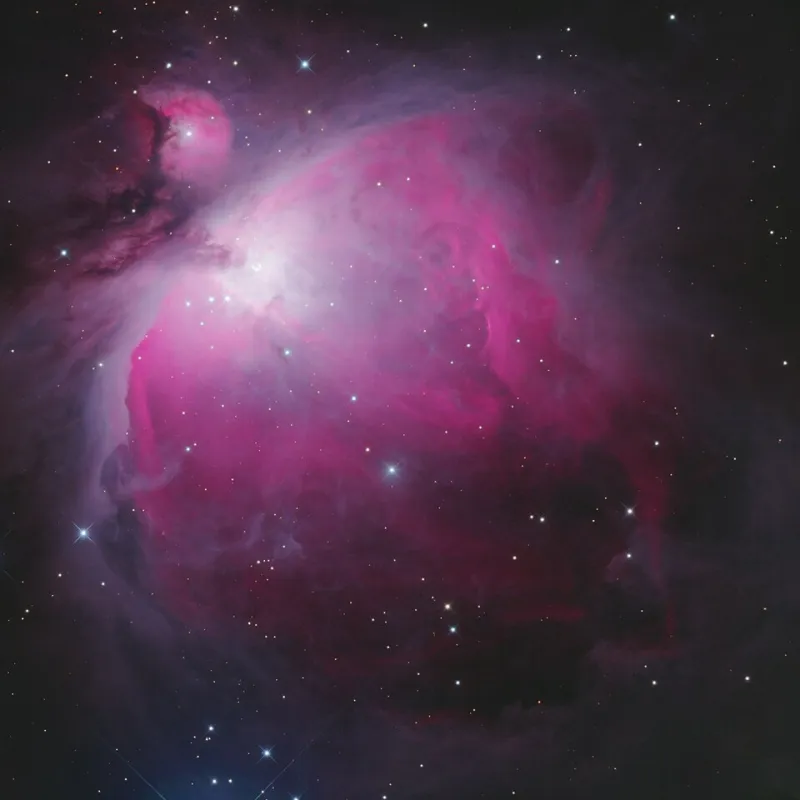
Photo: Brainandforce, CC BY 4.0, via Wikimedia Commons
Most discussions of deep-sky imaging focus on signal, calibration, and processing. Composition is often an afterthought, something applied at the end if time allows. Yet a frame with excellent data can feel inert, while a modest capture with thoughtful framing can feel intentional. The difference is often negative space—the dark regions around and within a subject.
Negative Space Is a Subject
In deep-sky frames, negative space is not empty. It is the context that gives a nebula its scale. The dark lanes in the Veil Nebula, the gaps between the Pleiades, the surrounding star field around the Andromeda Galaxy—these are compositional elements. When we crop tightly to fill the frame with signal, we remove the very space that makes the object legible. A frame that is all nebula can feel claustrophobic; a frame with breathing room can feel vast.
This is not a call for small subjects. It is a call for deliberate proportion. The Orion Nebula can dominate a frame and still leave room for the sword’s sweep. The North America Nebula can be cropped to its “continent” or framed to include the Pelican Nebula and the dark gap between them. Each choice tells a different story.
Orientation and the Weight of the Frame
Orientation is not arbitrary. A galaxy tilted across the diagonal has more dynamism than one aligned with the horizontal. A nebula that flows from corner to corner implies motion; one centered and level feels static. Before you finalize a crop, rotate the frame in 15-degree increments and notice how the subject’s apparent weight shifts.
In the field, this means planning the camera angle, not just the target. For a target like the North America Nebula, a diagonal orientation can echo the shape of the continent. For the Orion Nebula, a vertical crop can emphasize the sweep of the sword. For the Andromeda Galaxy, a horizontal frame that includes M32 and M110 gives the eye a path to follow. None of these choices is universally correct, but each should be made on purpose.
Scale and the Edges of the Frame
Scale is a function of focal length and sensor size, but it is also a compositional choice. A wide field that includes the surrounding dust and stars tells a different story than a close crop that isolates the core. Neither is inherently better, but each must be deliberate. Edge control matters as much: bright stars at the frame edge can pull the eye away from the subject. If a brilliant star sits at the border, either include it fully or crop it out. Partial stars at the edge look accidental.
The same applies to nebulosity. A wisp of gas that enters the frame and stops abruptly can look like a processing error rather than a natural boundary. Check the edges before you commit to a final crop, and consider whether a slightly wider field would resolve the ambiguity.
Examples from Familiar Targets
The Andromeda Galaxy is often framed to fill the sensor, but a wider field that includes its faint outer arms and the neighboring M32 and M110 can convey its true scale. The Pleiades benefit from negative space; the blue reflection nebulosity needs dark sky around it to read as haze rather than noise. The Whirlpool Galaxy can be composed with its companion at the edge or centered, but the interaction is clearer when both are given room. The Rosette Nebula can be cropped to the hole or framed to include the surrounding cluster; each choice changes the story.
For observers in the United States, seasonal placement matters. Orion and the winter Milky Way offer rich fields with natural negative space. The summer trio of the Lagoon, Trifid, and Sagittarius star cloud rewards wide framing. The Veil Nebula in Cygnus is a study in filaments and gaps; cropping too tightly removes the rhythm that makes it recognizable.
A Repeatable Framing Checklist
- Identify the subject’s dominant axis and align or deliberately contrast it.
- Decide the role of negative space: context, isolation, or rhythm.
- Check the edges for partial stars or truncated nebulosity.
- Rotate the frame mentally or in software; choose the orientation that feels inevitable.
- Consider the surrounding star field as part of the composition, not clutter.
- Ask whether the frame would still read if the subject were smaller.
- Record the framing in your log so you can reproduce or refine it.
Composition Is Not Decoration
Composition is not a final polish applied after processing. It is a decision made at the telescope, refined in processing, and judged with honesty. A frame succeeds when every element—subject, space, edge, and orientation—feels intentional. The universe provides the signal; the photographer provides the frame. Negative space is not what remains after the subject; it is what allows the subject to exist.