The Giants Await: Mastering Jupiter and Saturn Through Your Telescope in the Years Ahead
Deep-sky astrophotography tends to dominate the conversation in amateur astronomy circles. Nebulae, galaxies, and star clusters carry an undeniable romantic weight — objects so distant that their light has traveled millions of years to reach a backyard sensor. Yet there is a compelling argument that the solar system's two largest planets offer something equally profound, and considerably more immediate: the ability to watch genuine atmospheric dynamics unfold in real time, to observe moons crossing planetary disks, and to record detail that changes measurably from one night to the next.
Jupiter and Saturn are not static canvases. They are active, dynamic worlds, and the decade ahead presents a series of favorable viewing opportunities that amateur imagers should not overlook.
Why Planetary Imaging Stands Apart
The fundamental challenge of planetary imaging differs from deep-sky work in ways that affect both equipment choices and technique. Deep-sky targets are faint and extended, demanding long exposures, dark skies, and often narrowband filtration to isolate specific emission wavelengths. Planets, by contrast, are blindingly bright on an astronomical scale — so bright that long exposures would simply saturate a sensor into uselessness.
Instead, planetary imaging relies on high-frame-rate video capture: thousands of short exposures stacked and processed to extract the sharpest frames from a sequence blurred by atmospheric turbulence. This approach, known as lucky imaging, transforms the atmosphere from an adversary into a statistical problem. Capture enough frames, and some percentage will be captured during moments of exceptional atmospheric steadiness. Software such as AutoStakkert!, PIPP, and Registax then aligns and combines those best frames into a final image with detail that would be impossible to achieve in a single exposure.
The implication is significant: planetary imaging is, in some respects, more forgiving of less-than-perfect sky conditions than deep-sky work. A modestly light-polluted suburban backyard that would ruin a galaxy image can still produce excellent planetary results, provided the seeing — the steadiness of the atmosphere — is adequate.
Jupiter: A World That Never Stops Moving
With an equatorial diameter roughly 11 times that of Earth, Jupiter presents the largest planetary disk of any object in the night sky after the Moon and Sun. At opposition — the point at which it lies directly opposite the Sun as viewed from Earth — Jupiter's disk spans approximately 45 to 50 arcseconds, a size that resolves into extraordinary detail even through a 6-inch telescope under good conditions.
The most immediately recognizable features are the equatorial belts and zones: alternating dark and light bands of cloud running parallel to the equator, driven by the planet's rapid 10-hour rotation. Within those belts, experienced imagers can resolve festoons, ovals, and the interaction zones between adjacent atmospheric currents. The Great Red Spot — a storm system that has persisted for centuries, though it has been gradually shrinking in recent decades — remains one of the most photographically compelling features in the entire solar system.
Jupiter's four Galilean moons — Io, Europa, Ganymede, and Callisto — add another dimension to the observing experience. Their transits across the planetary disk, along with the transit of their shadows, occur regularly and are predictable weeks in advance using tools such as Sky & Telescope's Jupiter moon calculator. Capturing a moon transit in progress, with the moon's disk resolved against Jupiter's cloud bands, represents one of the more satisfying achievements available to a planetary imager.
For the imaging setup, a high-speed planetary camera — the ZWO ASI series and similar dedicated planetary cameras have become the standard — paired with a telescope in the 8-inch to 12-inch aperture range will yield excellent results. Larger aperture gathers more resolving power, though this advantage is frequently limited by atmospheric seeing rather than equipment. A Barlow lens (typically 2x to 5x) is used to increase the effective focal length and magnify the planetary disk to a scale appropriate for the camera's pixel size.
Jupiter reaches opposition roughly every 13 months. Observers in the United States should note that oppositions occurring when Jupiter is positioned in the southern constellations — Sagittarius, Scorpius, Capricornus — place the planet at lower elevation for northern-hemisphere observers, reducing its effective altitude and increasing atmospheric interference. Oppositions in northern constellations like Gemini or Cancer yield a higher, more favorable viewing angle. Planning multi-year imaging programs around these orbital geometries pays dividends in image quality.
Saturn: The Ringed World's Changing Face
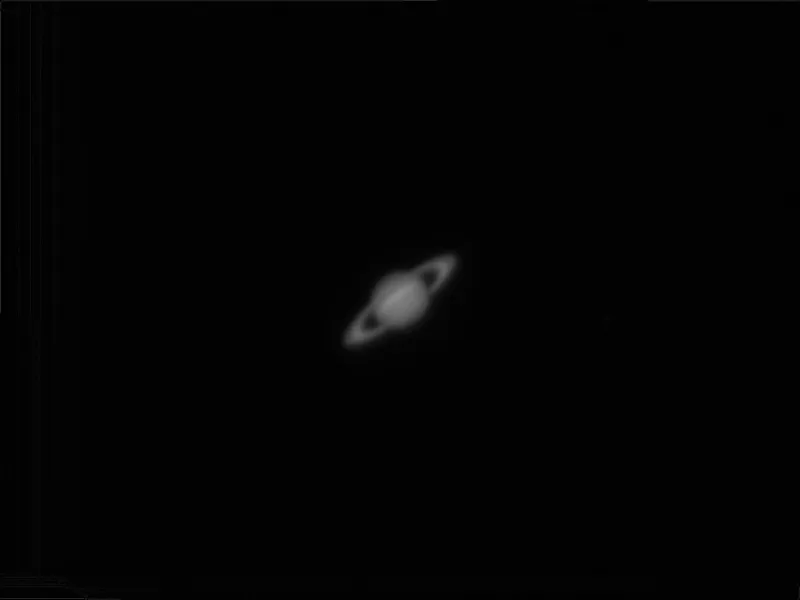
No object in the amateur telescope has produced more expressions of genuine astonishment than Saturn at high magnification. The ring system — inclined at up to 27 degrees relative to Earth's line of sight — gives Saturn an almost artificial quality, as though the planet were a model rather than a real world 75,000 miles in diameter.
What makes Saturn particularly compelling over the coming decade is the ring plane cycle. Saturn's rings are currently tilting toward edge-on as seen from Earth, with the minimum ring opening angle expected around 2025–2026. During this period, the rings will appear nearly flat, revealing the planet's oblateness more dramatically and offering a rare geometric perspective. Following this minimum, the rings will gradually reopen toward their maximum inclination around 2032, providing a progressively more spectacular view year after year through the late 2020s and into the 2030s.
Beyond the rings themselves, Saturn's disk reveals atmospheric banding similar in structure to Jupiter's, though generally more subdued in contrast. Periodic storm systems do erupt — the Great White Spot, a recurring storm that appears roughly every Saturnian year (approximately 29.5 Earth years), last erupted in 2010 and produced features visible to amateur imagers. The Cassini Division, the most prominent gap in the ring system, is resolvable under good conditions with as little as a 4-inch refractor, while larger apertures reveal the Encke Gap and subtle color gradations across ring zones.
Titan, Saturn's largest moon, is easily visible as a star-like point even in small telescopes. Through larger instruments under excellent seeing, experienced imagers have recorded a subtle orange hue reflecting Titan's thick nitrogen atmosphere — a detail that connects backyard observation to the extraordinary scientific discoveries made by the Cassini spacecraft.
Building a Planetary Imaging Workflow
A productive planetary imaging session follows a logical sequence. Collimation — the precise alignment of a telescope's optical elements — is more critical for planetary work than for wide-field imaging, and should be verified before each session. Thermal equilibration is equally important: a telescope moved from a warm interior to cool night air requires time for its optics and tube to stabilize, typically 30 to 60 minutes depending on aperture and design.
Capture sequences should run for 60 to 120 seconds at frame rates between 50 and 200 frames per second, depending on the camera's capability and the atmospheric conditions. From a typical sequence of 5,000 to 10,000 frames, the top 10 to 25 percent are selected for stacking. Wavelet sharpening in Registax or similar tools then enhances fine detail without introducing excessive noise.
Color balance and contrast adjustment — performed conservatively — complete the processing pipeline. The goal is accuracy and clarity, not dramatic enhancement. The most scientifically valuable planetary images are those that faithfully represent what the atmosphere actually looked like on a given night.
An Accessible Frontier
Planetary imaging occupies a distinctive position in the astrophotography landscape: it is demanding enough to reward sustained practice and study, yet accessible enough that meaningful results are achievable within a modest budget and from compromised sky conditions. For observers in light-polluted urban or suburban environments who feel excluded from deep-sky work, Jupiter and Saturn represent a genuine and rewarding alternative.
The coming years will bring favorable geometries, improving ring angles, and the continued refinement of amateur imaging technology. For those willing to invest the time to learn the techniques, the solar system's two great gas giants are ready to be explored — one high-speed video sequence at a time.