The Vanishing Dark: How Light Pollution Is Erasing America's Night Sky — and Where to Find What Remains
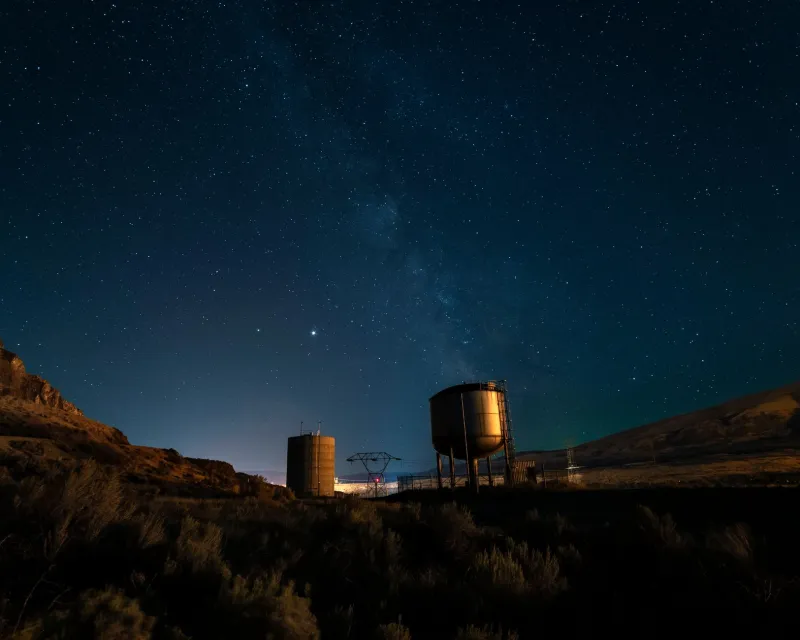
Stand outside on a moonless night in downtown Chicago, Atlanta, or Los Angeles, and look up. What you will see — a washed-out amber dome, a handful of stubborn stars punching through the haze — is not the sky. It is a ceiling. The actual sky, the one our grandparents knew without thinking about it, has been methodically replaced over the past century by something far less remarkable.
Light pollution is no longer an abstract environmental concern discussed in academic journals. It is a measurable, accelerating phenomenon that is physically altering what is visible from the surface of the Earth. For the roughly 80 percent of Americans who live under light-polluted skies, the Milky Way — the luminous band of our own galaxy — has become a rumor, something seen in photographs rather than overhead.
What the Data Actually Shows
The most comprehensive tool available for understanding artificial sky brightness is the Light Pollution Map maintained at lightpollutionmap.info, which aggregates satellite data from NOAA and the European Space Agency's Suomi NPP platform. Overlaid with the Bortle Dark-Sky Scale — a nine-point classification system ranging from pristine Class 1 darkness to the severely light-polluted Class 9 found in urban cores — the map paints a striking portrait of a nation increasingly cut off from its own sky.
The northeastern corridor from Boston to Washington, D.C. is effectively a continuous Class 8–9 zone. The Great Lakes region, Southern California, and the Texas Gulf Coast tell similar stories. A 2016 study published in Science Advances by Fabio Falchi and colleagues estimated that 99 percent of Americans live under light-polluted skies by any meaningful definition, with roughly 80 million unable to see the Milky Way at all.
More troubling is the rate of change. A 2023 analysis published in Science by researchers including Globe at Night participants found that the night sky is brightening at approximately 9.6 percent per year as perceived by the human eye — a figure far exceeding earlier satellite-based estimates, which tend to miss the blue-rich LED wavelengths that scatter most aggressively in the atmosphere.
Why LED Conversion Is a Double-Edged Development
The widespread municipal adoption of LED street lighting, while laudable for energy efficiency, has introduced an unintended consequence. Older high-pressure sodium fixtures emitted warm, orange-toned light that, while still polluting, scattered somewhat less in the atmosphere than cooler alternatives. Many LED replacements operate at color temperatures of 4000K or higher, emitting substantial blue-spectrum light that Rayleigh scatters more efficiently — meaning it travels farther, brightens a wider area of sky, and is more disruptive to human circadian rhythms and nocturnal wildlife alike.
The International Dark-Sky Association (IDA) advocates for fixtures rated at 3000K or below, fully shielded to direct light downward rather than outward. Some municipalities, including Tucson, Arizona — home to several major observatories — have adopted these standards proactively. Progress elsewhere remains inconsistent.
Where Genuine Darkness Survives
The encouraging reality is that true dark sky still exists within the continental United States, and for astrophotographers and visual observers alike, these locations represent irreplaceable resources.
The American Southwest remains the continent's most reliable dark-sky region. The Colorado Plateau, encompassing portions of Utah, Arizona, Colorado, and New Mexico, contains an extraordinary concentration of protected dark sky. Natural Bridges National Monument in Utah holds the distinction of being the world's first International Dark Sky Park, designated in 2007. The region surrounding Capitol Reef National Park and Bryce Canyon offers Class 1–2 conditions on moonless nights — among the darkest accessible sites in the lower 48 states.
West Texas provides another stronghold. The area surrounding Big Bend National Park and the Davis Mountains, anchored by the McDonald Observatory near Fort Davis, sits far from any major urban center. The observatory's Frank N. Bash Visitors Center hosts public star parties that draw observers from across the country.
The Northern Rockies and Great Plains offer vast stretches of low population density and corresponding darkness. Cherry Springs State Park in north-central Pennsylvania — remarkably, within a day's drive of roughly 70 million Americans — is designated an International Dark Sky Park and regularly achieves Bortle Class 2 conditions, a testament to what geographic circumstance and proactive land management can preserve even in the densely populated East.
The Upper Midwest and northern Minnesota, particularly the Boundary Waters Canoe Area Wilderness, provide exceptional conditions that surprise visitors accustomed to the light domes of Minneapolis or Chicago. Hawaii's Mauna Kea and the summit regions of Haleakalā National Park on Maui represent some of the finest observing conditions on Earth, though access considerations apply.
Finding Dark Sky Near Major Cities
Not every stargazing excursion requires a cross-country journey. The following approximate driving distances offer perspective for urban observers:
- New York City: Cherry Springs State Park (~4 hours), Delaware Water Gap (~90 minutes for modest improvement)
- Los Angeles: Anza-Borrego Desert State Park (~2.5 hours), Joshua Tree National Park (~2.5 hours)
- Chicago: Starved Rock area (~1.5 hours for partial improvement), Upper Michigan Peninsula (~5 hours for genuine darkness)
- Dallas–Fort Worth: Copper Breaks State Park (~3 hours), Davis Mountains region (~6 hours for premier conditions)
- Atlanta: Cohutta Wilderness, Georgia (~2 hours), Pisgah National Forest, North Carolina (~2.5 hours)
The IDA's Dark Sky Finder tool and the Globe at Night citizen science program both offer searchable databases of certified dark sky locations updated regularly with community observations.
The Broader Stakes
The loss of dark sky is not merely an inconvenience for astronomers and astrophotographers. Artificial light at night disrupts migratory bird navigation, suppresses sea turtle nesting behavior, interferes with pollinator activity, and measurably affects human sleep quality and health outcomes. The night sky is also a cultural inheritance — one that has informed navigation, agriculture, mythology, and scientific inquiry across every human civilization in recorded history.
For those who photograph the cosmos, the urgency is practical as well as philosophical. Dark sky locations that appear on maps today may not retain their Bortle Class 2 or 3 ratings a decade from now as surrounding communities grow. The frames captured tonight, under skies that still reveal the full sweep of the galactic core, may eventually document something that no longer exists in that form.
The invitation, then, is to go — sooner rather than later. Find the nearest dark sky park. Drive past the last highway interchange and watch the stars multiply. Point a camera at the horizon and let the Milky Way fill the frame. These are not merely recreational pursuits. They are acts of attention paid to something genuinely worth preserving.