Calibrating the Dark: How Flat Frames Protect Every Photon You Collect
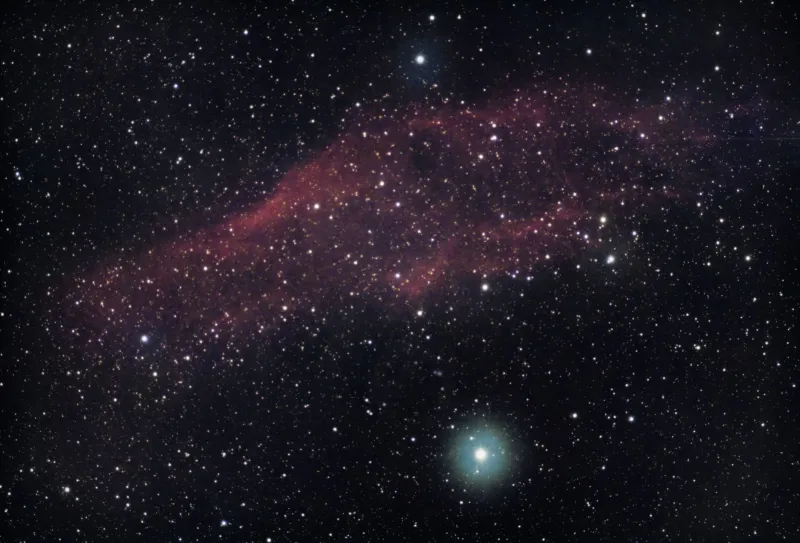
Imagine spending four hours under a dark sky collecting photons from a faint galaxy, only to discover in post-processing that the corners of every frame are noticeably dimmer than the center, a circular dust shadow obscures a section of the spiral arm you were most hoping to reveal, and a subtle diagonal gradient runs across the entire field. None of these problems originated in the sky. They were introduced by your own optical system—and every one of them was preventable.
Flat-field calibration is not a peripheral concern for advanced imagers. It is a fundamental step in the signal-to-noise chain, as essential as dark subtraction and bias correction. Yet it remains the calibration frame most frequently misunderstood, inconsistently executed, or simply omitted. The cost of that omission is measured in lost dynamic range, hidden detail, and hours of frustrated processing time.
Why Your Optical System Lies to You
A perfect optical system would deliver uniform illumination across the entire sensor—every pixel receiving the same number of photons from a uniformly bright source. No such system exists in practice.
Vignetting is the most pervasive form of optical non-uniformity. It occurs when the edges of the light cone entering the optical tube are partially obstructed by the focuser barrel, field flattener, filter cell, or the aperture stop of the optical design itself. The result is a characteristic darkening toward the corners and edges of the frame, often following a smooth radial gradient. In some fast refractors and camera lenses used for wide-field imaging, corner illumination may fall to sixty or seventy percent of the center value—a difference of nearly half a stop.
Dust particles on the sensor's cover glass, the rear element of the optical tube, or the surface of a filter cast soft-edged shadows called dust donuts. These circular artifacts are particularly visible against smooth gradient backgrounds—a patch of emission nebulosity, a bright galactic core—and they move in position as filters are changed or the camera is rotated.
Pixel-to-pixel sensitivity variation adds a third layer of non-uniformity. Individual photosites on a CMOS or CCD sensor respond to incident light with slightly different efficiencies. While modern sensors are highly uniform, the residual variation is measurable and, at high signal-to-noise ratios, visible in processed images as a subtle fixed-pattern texture.
A flat frame captures all of these effects simultaneously. By imaging a uniformly illuminated source, you record the combined response pattern of your entire optical system. Dividing your light frames by this response pattern—the mathematical operation performed during calibration—corrects each of these non-uniformities in a single step.
The Critical Requirement: Optical Consistency
Flat frames are only useful if they accurately represent the optical state of the system during your actual imaging session. This requirement is more demanding than it first appears.
Every element of the imaging train must remain identical between the time you capture your flats and the time you captured your lights. This means the same camera orientation, the same filter, the same focuser position, and the same field flattener or reducer in place. Rotating the camera by even a small angle shifts the position of dust shadows on the sensor relative to the frame, rendering the flat useless for correcting them. Changing focus shifts the size and shape of dust donuts. Removing and replacing a filter may introduce a new dust particle or shift an existing one.
For imagers using filter wheels and dedicated astronomy cameras, maintaining this consistency is relatively straightforward—the optical train is mechanically fixed. For DSLR users who regularly remove the camera from the telescope, establishing a repeatable rotation index mark on the camera body and focuser is a worthwhile precaution.
Methods for Capturing Flat Frames
Several practical approaches exist for illuminating the flat-field source. Each has trade-offs in convenience, uniformity, and repeatability.
Twilight sky flats use the sky itself as an illumination source during the brief window after sunset or before sunrise when the sky is bright but stars are not yet resolved. The sky provides an extremely uniform, spectrally broad source, and flats captured this way are generally excellent in quality. The limitation is the narrow time window—typically five to ten minutes of usable sky brightness—and the need to capture flats at the same sky region as your imaging target to avoid color gradients from sky polarization.
Light panel flats use a commercially available LED flat-field panel or a DIY equivalent—a sheet of white acrylic diffusion material illuminated from behind by a tablet screen or LED light pad. These panels allow flat capture at any time, including immediately before or after an imaging session while the optical train remains undisturbed. The primary concern is ensuring the panel's illumination is sufficiently uniform; low-quality panels can introduce their own gradients. Placing a sheet of diffusion material between the panel and the telescope aperture improves uniformity substantially.
T-shirt flats represent the most stripped-down DIY approach: stretching a clean white T-shirt over the telescope aperture and pointing the tube at an evenly illuminated surface (a white wall, a gray overcast sky, or a laptop screen set to solid white). Despite their inelegance, T-shirt flats capture genuine optical non-uniformity and are entirely adequate for many imaging situations.
Regardless of method, the target histogram value for flat frames is critical. Flats should be exposed to approximately thirty to fifty percent of full well capacity—roughly in the middle third of the histogram. Underexposed flats suffer from read noise contamination. Overexposed flats clip the highlights and lose linearity. Fifteen to thirty individual flat frames, combined into a master flat via median stacking, provide sufficient signal-to-noise to avoid introducing additional noise during the calibration process.
Common Mistakes and Their Consequences
Capturing flats at the wrong exposure level is perhaps the most frequent error. An underexposed flat has poor signal-to-noise in the very regions—corners, dust shadows—where accurate correction is most needed. The correction applied to your lights will itself be noisy, adding a pattern to the image rather than removing one.
Changing the optical configuration between lights and flats is the second most consequential mistake. An imager who captures lights with a narrowband hydrogen-alpha filter and then captures flats with the same filter but after removing and replacing the filter cell has introduced a systematic error that cannot be corrected in post-processing. The flat will not match the actual dust positions during the imaging session.
Using flats from a previous session without verifying that the optical train has not changed is similarly risky. Dust migrates. Sensors accumulate particles. A library of master flats has genuine value for stable, permanently mounted systems, but should be validated periodically by examining a single raw flat against the archived master.
What Proper Calibration Reveals
The most compelling argument for disciplined flat-field practice is empirical: take a poorly calibrated image and a properly calibrated one from the same raw data and compare them. The difference is not subtle. Corners that appeared hopelessly dark recover genuine nebular signal. Dust shadows that seemed to require masking and manual correction disappear cleanly. The image acquires a tonal smoothness across the field that allows aggressive stretching without the gradients and artifacts that previously forced restraint.
Flat-field correction does not add information to your images. It removes the optical system's distortions to reveal information that was always present in your raw data, waiting to be uncovered. That is, in a sense, the entire purpose of careful astrophotography: not to manufacture beauty, but to remove every obstacle between the sensor and the truth of what the sky actually contains.