The Button and the Craft: What Push-Button Astronomy Teaches—and What It Lets You Forget
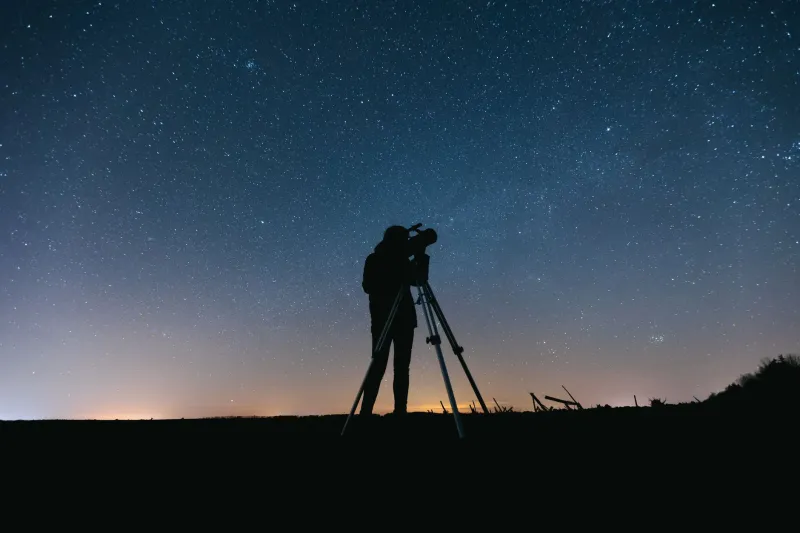
Smart telescopes have moved from novelty to routine equipment in the American amateur market. In 2026, a newcomer can place a compact all-in-one instrument on a patio, tap a target on a tablet, and return an hour later to a stacked, color-calibrated image of the Whirlpool Galaxy. The appeal is obvious. The paradox is subtler: the same design that removes friction also removes many of the decisions through which imagers traditionally learn.
The Promise of the Button
There is nothing dishonest about the promise. Smart telescopes solve real problems. They reduce the weight of a first rig, shorten the distance between curiosity and a finished image, and make deep-sky photography possible for people who do not have the time, space, or patience for a conventional mount, camera, guide scope, and acquisition laptop. For a family in a suburban townhouse, a traveler with a compact car, or an outreach volunteer who needs a reliable crowd-pleaser, the appeal is rational.
The image that appears on the screen is not a trick. It is the product of real optics, real sensors, and real software. The question is what the user learns along the way—and what the user is allowed to skip.
A Different Curriculum
A traditional rig is a sequence of visible dependencies. The mount must be leveled and aligned. The optics must be focused and, in some designs, collimated. The camera must be cooled, connected, and calibrated. The guide system must be focused and configured. Every failure points to a link in a chain, and every repair teaches something about how the chain behaves under load.
A smart telescope compresses that chain into a sealed system. The user chooses a target, confirms focus, and lets the instrument manage tracking, stacking, and often calibration. This is not a lesser curriculum; it is a different one. The user learns framing, target selection, exposure budgeting, and the rudiments of processing. What the user may not learn is why the mount behaved badly when a cable snagged, why stars grew soft as the temperature dropped, or why one filter produced a different background gradient than another.
Those omissions matter because they are exactly the skills that transfer when the user eventually wants more control. The person who has diagnosed a meridian flip, a USB dropout, and a dew heater failure has a mental model that survives a change of equipment. The person who has only pressed a button may have a beautiful first image and no vocabulary for the first serious problem.
Data Without Diagnostics
Many all-in-one systems now export raw or calibrated frames, and that is a meaningful improvement. But access to data is not the same as access to diagnosis. When a conventional rig produces trailed stars, the imager can inspect individual subs, check guide logs, measure eccentricity, and separate wind from periodic error from differential flexure. When a smart telescope produces a flawed result, the user often has fewer levers and more questions.
This is efficient, but it changes ownership. The user owns the image; the system owns much of the reasoning. That trade can be perfectly acceptable for an observer whose goal is a satisfying picture of the Orion Nebula. It becomes a limitation for an observer whose goal is to understand why the picture looks the way it does.
Troubleshooting as Inheritance
Astronomy has always passed skills down through trouble. A club member shows a newcomer how to balance a mount, how to read a histogram, how to tell dew from frost, how to recognize a bad cable before it ruins a night. Those lessons are not glamorous, but they are portable. They turn a hobby into a craft.
Smart telescopes do not eliminate that inheritance; they relocate it. The community around all-in-one systems is often generous, but much of its troubleshooting is necessarily external. Users exchange settings, firmware versions, and support tickets. That is useful, and sometimes it is the only practical route. Yet it can leave the imager dependent on the manufacturer's interpretation of a problem rather than on a personal understanding of the instrument.
Community at the Edge of Automation
There is also a social trade-off. Traditional imaging communities tend to organize around process: acquisition sequences, calibration frames, mount tuning, processing workflows. Smart telescope communities tend to organize around results: target lists, finished images, travel cases, and sharing. Both are legitimate. But a community that celebrates only the product can subtly discourage the question that matters most: what would I do differently next time?
The healthiest version of push-button astronomy uses the saved time well. It invests that time in sky knowledge, in learning to read an image critically, and in understanding what the software is doing on the user's behalf. The instrument becomes a scout rather than a substitute for curiosity.
Choosing the Trade You Can Live With
The smart telescope is not a shortcut to expertise, but it is not a trap either. It is a trade. It gives convenience, portability, and a lower failure rate. It takes away some diagnostic intimacy and some of the productive frustration that builds technical judgment.
For a US observer who wants to image between work, weather, and family obligations, that trade may be exactly right. For an observer who wants to build a remote observatory, run a filter wheel, chase faint narrowband signal, or troubleshoot a mount at two in the morning, the conventional path still teaches more per session. The worst outcome is buying a smart telescope to avoid learning, then concluding that astronomy is dull because the button never explained the sky. The best outcome is using the button to get started, then reinvesting the saved hours in the craft that remains.
Capture the universe one frame at a time. The frame still belongs to the person who understands what went into it.