Beyond Human Vision: The Science of How Cameras Unlock the Hidden Colors of the Cosmos
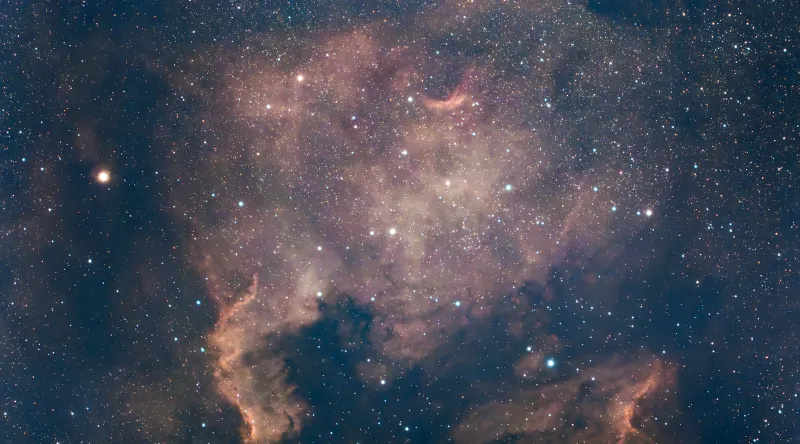
Stand beneath a truly dark sky in rural Wyoming or the high desert of New Mexico, and you will notice something humbling: the Orion Nebula, one of the most celebrated objects in the night sky, appears as little more than a soft, gray smudge. Now load a ten-minute exposure of that same nebula captured with a modest DSLR, and an entirely different universe materializes—billowing clouds of rose-red hydrogen, electric blue ionized oxygen, and dark pillars of dust carved by stellar winds. The question that inevitably follows is a reasonable one: Is that actually what it looks like?
The short answer is yes—and no. Understanding why requires a brief tour through human physiology, detector physics, and the electromagnetic spectrum.
The Eye's Honest Limitations
The human eye is a remarkable optical instrument, but it was not designed for the night sky. At low light levels, the eye transitions from cone-based color vision to rod-based monochromatic vision, a process called scotopic adaptation. Rods are exquisitely sensitive to dim light, but they carry almost no color information. More critically, the eye cannot accumulate light over time the way a camera sensor can. Each moment, the visual system refreshes, discarding photons that have not already triggered a neural response.
This means that for objects radiating extremely low fluxes of light—distant nebulae, faint galaxies, tenuous supernova remnants—the eye never accumulates enough photons to stimulate the color-sensitive cones at all. The result is the gray smudge phenomenon: the object is there, the light is arriving, but the biological detector simply cannot integrate it long enough to register color or fine structural detail.
How Sensors Integrate Light Over Time
A camera sensor operates on a fundamentally different principle. Whether it uses a CCD or the CMOS architecture common in modern mirrorless cameras, the sensor accumulates charge as photons strike individual pixels. The longer the shutter remains open, the more charge accumulates—and crucially, this process does not reset the way human vision does.
A single 30-second exposure collects thirty times more photons than a one-second exposure. Stack a hundred such frames through dedicated astrophotography software, and you have effectively simulated a 50-minute continuous exposure, pushing signal far above the noise floor. Objects that would never activate a human rod cell become vivid and structurally complex when captured this way.
This is why long-exposure astrophotography is not a trick or an embellishment. It is a physically valid method of measuring light that simply operates on timescales incompatible with biological vision.
Wavelength Sensitivity and the Hydrogen-Alpha Advantage
Beyond exposure time, there is a second dimension in which cameras surpass the eye: spectral sensitivity. The human eye responds to wavelengths roughly between 380 and 700 nanometers, with peak sensitivity in the green-yellow range near 555 nm. Critically, sensitivity drops sharply at the red end of the spectrum, particularly beyond 650 nm.
Emission nebulae—clouds of gas energized by nearby young stars—radiate much of their light at very specific wavelengths tied to atomic transitions. The most important of these is hydrogen-alpha, at 656.3 nm. This wavelength sits in the deep red portion of the visible spectrum, right where human cone sensitivity is weakest. A standard camera sensor, by contrast, retains meaningful sensitivity at 656 nm, and dedicated astrophotography cameras (often described as "Ha-modified") remove an internal filter that manufacturers install to suppress red sensitivity for daytime photography.
The result is dramatic. Nebulae that appear featureless to the eye—the California Nebula, the Heart and Soul Nebulae in Cassiopeia, the vast Barnard's Loop encircling Orion—erupt with structure and color when imaged with a sensor capable of capturing hydrogen-alpha emission.
Narrowband imaging takes this principle further. Using filters that transmit only a few nanometers of bandwidth centered on hydrogen-alpha, ionized sulfur (672 nm), and doubly ionized oxygen (501 nm), astrophotographers can image from light-polluted suburban skies and still extract scientifically meaningful data. The famous Hubble palette—mapping these three wavelengths to red, green, and blue channels—produces the dramatic teal-and-gold color schemes seen in NASA imagery. These colors are real in the sense that they represent real emission from real atomic transitions; the palette simply maps those emissions to visible colors for human interpretation.
Are the Colors "Real"?
This is the philosophical heart of the matter, and it deserves a precise answer. Astrophotography images represent genuine physical measurements of genuine electromagnetic radiation. The hydrogen-alpha emission that produces red tones in a nebula image is not invented; it is measured. The oxygen-III emission that generates blue-green tones is real ionized gas radiating at a specific, predictable wavelength.
What varies between images is the mapping of those measurements to a visual representation. A true-color image attempts to render wavelengths as the eye would perceive them if sufficiently sensitive. A narrowband false-color image remaps wavelengths to colors that make structural differences visible to human observers. Both are honest representations of the data; they simply answer different scientific or aesthetic questions.
The analogy most useful here is medical imaging. An MRI scan does not look like what a surgeon sees with the naked eye, but it is unambiguously real data about a real biological structure. Astrophotography operates on the same principle: the image is a visualization of real measurements, optimized for human perception.
Practical Implications for Your Imaging Sessions
Understanding this science should reshape how you approach target selection and post-processing. When imaging emission nebulae, prioritize sensors with strong red-channel sensitivity or invest in a dedicated clip-in hydrogen-alpha filter. When working on reflection nebulae—which scatter starlight rather than emit it—true-color processing will more closely approximate what a theoretically color-sensitive eye might see, since the light source is ordinary stellar radiation.
In post-processing, resist the temptation to view color calibration as a purely aesthetic exercise. Tools such as PixInsight's Photometric Color Calibration or the newer Graxpert platform use reference star databases to anchor your image's color response to physically meaningful values. The goal is not to make the nebula look dramatic (though that often follows naturally); the goal is to let the data speak accurately.
The cosmos is genuinely, extravagantly colorful. Your camera, more than any optical eyepiece, is the instrument capable of revealing that color in its full complexity. The gap between what your eye perceives at the eyepiece and what your sensor captures in a long-exposure frame is not a distortion of reality. It is a window into a universe that has always been there, waiting for a detector patient enough to look.