Negative Space, Leading Lines, and the Art of Telling a Story with Starlight
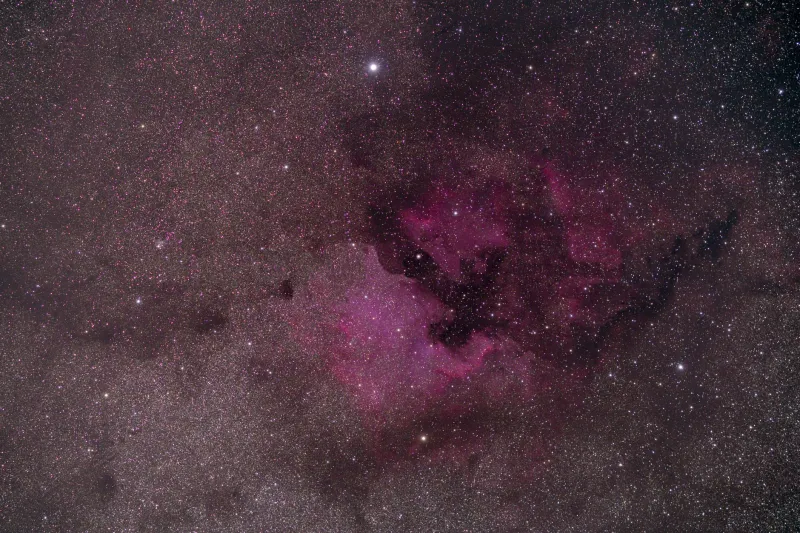
There is a moment that many astrophotographers know well: the image is sharp, the noise is controlled, the calibration frames did their job, and yet something about the final result feels flat. Technically, it passes every test. Emotionally, it says very little. The problem is rarely the equipment, the processing pipeline, or even the target itself. More often, it is composition—the deliberate arrangement of visual elements within the frame—that separates a photograph people pause over from one they scroll past.
CelestialFrame has previously addressed the foundations of compositional thinking in night-sky imaging. This piece moves beyond those foundations into the subtler, more demanding territory that fine art photographers and landscape artists have explored for generations, and considers how those principles translate directly to the challenges of deep-sky work.
Why Composition Matters More in Astrophotography Than You Might Assume
It is tempting to treat the night sky as a subject that composes itself. The Orion Nebula is where it is; the Andromeda Galaxy occupies a fixed position relative to the stars around it. The astrophotographer, the argument goes, is a scientist first and an artist second.
This framing is worth challenging. Even when the target is fixed, the photographer controls field of view, orientation, the inclusion or exclusion of foreground elements, the balance of bright and dark regions, and the precise placement of the primary subject within the image boundary. Each of these decisions carries compositional weight. Ignoring them does not produce neutral images—it produces accidental ones.
The Strategic Use of Negative Space
Negative space—the empty or relatively featureless regions surrounding a primary subject—is one of the most underutilized tools in astrophotography. In a medium where the instinct is often to fill the frame with as much detail as possible, deliberate restraint can be far more powerful.
Consider a small, intensely detailed planetary nebula positioned against a deep, star-sparse field. By allowing generous dark space to surround that object rather than cropping tightly, the photographer conveys scale in a way that no caption can replicate. The vastness of the surrounding void becomes part of the story. The nebula earns its isolation.
This technique works equally well with emission nebulae that have strong, defined edges. Allowing dark molecular cloud regions to occupy a significant portion of the frame creates visual tension—the eye is drawn toward the luminous gas not because it fills the image, but because the darkness makes it feel earned.
Leading Lines and the Geometry of Attention
Leading lines are a compositional device with roots in Renaissance painting, refined through centuries of landscape photography. In the context of deep-sky imaging, they require a more creative interpretation, because the sky rarely provides the literal paths and rivers that guide the eye in terrestrial photography.
Instead, astrophotographers can work with implied lines: the elongated sweep of a dust lane through a galaxy, the curved arc of a bow shock nebula, the diagonal trajectory of a star-forming filament. These structures function as internal leading lines, directing the viewer's attention from one part of the image to another and creating a sense of visual movement across an otherwise static frame.
When incorporating terrestrial foreground elements—a ridge line, the edge of a canyon, a row of Joshua trees against the Milky Way—the opportunity for classical leading lines becomes more explicit. The most effective foreground elements do not merely anchor the image; they actively direct the eye upward and inward toward the celestial subject.
Rethinking the Rule of Thirds
The rule of thirds is well known even among casual photographers, but its application in astrophotography is frequently mechanical rather than thoughtful. Placing the primary nebula at one of the four intersection points of a three-by-three grid is a reasonable starting position, but it is not a destination.
More nuanced compositional thinking asks not just where the subject sits, but what that placement implies. A galaxy positioned in the lower-left third of the frame, with open space extending to the upper right, implies motion and trajectory—the galaxy appears to be moving into the frame rather than sitting passively within it. This single choice introduces narrative without altering a single pixel of data.
Conversely, centering a subject can be an equally deliberate choice when the goal is to convey symmetry or power. The Helix Nebula, with its near-perfect radial symmetry, often reads more forcefully when centered than when offset. The rule of thirds is a default, not a doctrine.
Intentional Off-Center Framing and Visual Weight
Visual weight refers to the degree to which different elements in an image attract the eye. Bright objects carry more weight than dim ones; high-contrast edges carry more weight than smooth gradients; isolated objects carry more weight than clustered ones.
Mastering off-center framing means understanding how visual weight distributes across the image plane and using that distribution intentionally. A bright core galaxy positioned in one quadrant of the frame can be balanced against a dense star field, a faint tidal stream, or even a companion galaxy in the opposing quadrant. The result is an image that feels balanced without being symmetrical—a distinction that separates compositionally sophisticated work from the merely centered.
This is also where mosaic imaging opens interesting creative possibilities. When assembling multi-panel mosaics of large targets like the Veil Nebula complex or the Cygnus Wall, the photographer has genuine latitude in deciding which portions of the full field to include, how to orient the final canvas, and where to place the most visually dominant structures. These decisions compound the compositional impact of every individual framing choice.
Bringing It All Together: Composition as Previsualizing the Final Frame
Ansel Adams developed the concept of previsualization—the practice of mentally constructing the final image before the shutter opens. For astrophotographers, this practice is complicated by long exposures, mount tracking, and the need to plan sessions weeks in advance. But the underlying discipline is no less valuable.
Before framing a target, consider: What is the visual story this image should tell? Is it about scale, isolation, complexity, motion, or symmetry? Which compositional tools—negative space, leading lines, asymmetric placement, visual weight—serve that story most directly? The answers to these questions should inform every practical decision that follows, from field rotation to mosaic panel overlap.
The night sky offers an essentially infinite archive of subjects. The frame you choose to place around any one of them is the decision that makes the difference between a record and a revelation.